March 17, 2007

Conversions Unveiled

An interesting article from Wednesday in the Milwaukee Journal Sentinel (JS) Online about the new book, Becoming Muslim: Western Women's Conversions to Islam, by Anna Mansson McGinty. Amazon's book description reads, "While Islam has become a controversial topic in the West, a growing number of Westerners find powerful meaning in Islam. Becoming Muslim is an ethnographic study based on in-depth interviews with Swedish and American women who have converted to Islam. Proceeding from the women’s life-stories, the author explores the appeal of Islam to some Western women and the personal meaning assigned to the religion. While conversion is often perceived as entailing a dramatic change in worldview, the women’s experiences point to an equally important continuity. Notably, the conversion is triggered by particular personal ideas and quests, and within Islam the women can further explore already salient thoughts. The work appeals to students in the fields of anthropology, religious studies, psychology, and women’s studies, interested in identity, conversion, and gender."

In the 1990s, when she first set out to interview women about their conversions to Islam, Anna Mansson McGinty expected to meet the wives of devout Muslims, women whose religion had come from their husbands.

But a more complex picture emerged as McGinty, an assistant professor at the University of Wisconsin-Milwaukee, began delving into the women's stories for her 2006 book, "Becoming Muslim: Western Women's Conversions to Islam."

McGinty, 35, interviewed women in her native Sweden and in the United States, and found no typical Muslim convert. Nor did she find conversions that could be reduced to a single act.

"The book's main aim," she said, "is to show that conversion is not, as many scholars have described it, a one-time event. It's a constant process. It's never-ending."

Among the nine women profiled in the book was Mariam, an American-born graduate student in anthropology who went to do field work in an oasis in northern Africa, and while in the field converted to Islam at age 25. Years later, she married a man who also was a Muslim convert.

There was Fatimah, a former Catholic who had abandoned religion in college, then, as a married mother of two, watched a documentary on nuclear holocaust that led her to embark on a spiritual quest. In the course of this quest, she would divorce her husband, convert to Islam and later marry a Muslim man.

"Becoming Muslim" (Palgrave Macmillan, 2006, $65) sheds light on how women in Islam are perceived, an issue that reflects the rift between the Muslim world and the West.

Yvonne Haddad, a professor who teaches the history of Islam and Christian-Muslim relations at Georgetown University, said a fundamental misconception about Islamic women stems from an old colonialist notion.

"There is a whole history of European colonialism," she said, "that justified the occupation of Muslim lands by saying, 'We have to save Muslim women.' "

Early Crusaders saw Muslim women in their veils and imagined they were abused by their men, hidden under cover, Haddad said.

Today the idea persists, though it is balanced by a view from the opposite side of the cultural divide.

"Muslims look at Western women as being abused by their husbands because they allow strange men to talk and flirt with the women," Haddad explained.

Negative ideas about the treatment of Islamic women, however, are not without some grains of truth.

There have been forced marriages and "honor killings" of women in certain Muslim cultures, said Marcia Hermansen, director of the Islamic World Studies program at Loyola University of Chicago, but such practices are not part of most Muslims' "everyday reality. It's not sanctioned by the religion."
[Note: Honor killings are not solely a "Muslim phenomenon," but have been done by members of other religions, including Christians.]

"Under the Taliban, certainly women were hideously oppressed," said Leila Ahmed, a professor at Harvard Divinity School.

At the same time, Ahmed said, "nobody has ever asked me to explain why there have been women heads of state in Turkey, Indonesia, Pakistan and Bangladesh. How many European and American women heads of state have there been?
[Note: To my knowledge, only two, the UK (Margaret Thatcher) and Germany (Chancellor Angela Merkel).]

"The extraordinary achievements and freedoms of Muslim women are simply invisible."

Hermansen pointed out that some of these heads of state were the wives or daughters of leaders, evidence in her view that "family identity trumps gender distinctions for the most part."

...

McGinty's interviews with the nine women were never intended to be a scientific survey. Instead, they offer a window into the journey toward conversion and the consequences of that decision.

One of the Swedish women told McGinty that the decision to wear the veil changed the way fellow Swedes viewed her. The woman said that strangers assumed she was an immigrant and would speak slowly, asking, "Do . . . you . . . speak . . . Swedish?"

The veil has become a powerful symbol of the complexity of Islamic conversion.

McGinty found that converts were eager to wear the veil to identify themselves as Muslim, yet also saw it as something "intimately linked to the stereotypes of Muslim women."

Some women, McGinty said, remove the veil before entering their workplaces.

Women also told McGinty that, since their conversions, people seemed to view them as boring or serious, almost discounting the possibility that they might have a sense of humor.

All of the women, McGinty said, found something in Islam that aligned to a core part of their personality.

Some found that zakat, or alms giving to the poor, which is one of the five pillars of Islam, fit a belief in social justice.

Others found in Islam a faith that spoke to their sense of religious yearning or spiritual quest.

Some of the women, she said, found that Islam allowed them to try out a new kind of femininity, one that emphasized modesty and placed value on who a woman is rather than what she looks like.

"Conversion triggers profound questions to the self," McGinty wrote in her book. "It heightens the awareness and prompts reflections of who one is, who one was, and where one is heading."

March 12, 2007

Answers for John and Mary

Mary wrote: "I don’t get how Rayyan can be a doctor. Well at least a doctor with Male patients. She should only treat females."

No doubt there are some Muslim countries where there are male doctors who treat only men and female doctors who treat only women. However, this is not a universal practice around the world. In fact, I, a Muslim male, have a female Muslim doctor.


John wrote: "I have heard it said that while it is forbidden for a Muslim woman to marry a non-Muslim man, the reverse is not true. Did I understand this correctly?"

Yes, this is true; Muslim men are allowed to marry believing Christian and Jewish women per the Qur'an.


"...is the non-Muslim wife expected/allowed to continue in her own religious practices?"

The wife may continue in her religious traditions, although she will be encouraged to become a Muslim in time. Still, some do, some don't.


"Are there limits on what religions she can belong to?"

The Qur'an specifically says Christian and Jewish women. However, it wouldn't surprise me if Muslim men marry women of other religions in areas of the world where Christianity and Judaism isn't as common (e.g., South Asia).


"Would Fatima be less upset about her son studying with a ‘white’ girl than Babar was about his daughter’s study buddy?"

No, she would (or should) be just as upset. There's a hadith that says (paraphrasing) when an unmarried man and woman are in a room together alone, Shaitan is the third. In this particular episode, both Rayyan and Babar's daughter should have known better.

BTW, one thing that's grated on me a little is that Fatimah's name throughout this show is always mispronounced. Among Muslim women, "Fatimah" is pronounced "Fah-TEE-mah." Trust me on this; I know all too well. :)

March 08, 2007

The Hadith of Jibril

In his recent diary, There is no god but God, Abdur Rahman wrote, "In a very important prophetic tradition, Prophet Muhammad (alaihi al-salatu wa al-salam) is reported to have said: 'Then he (the man) said, "Inform me about Ihsan..."'"

I thought this hadith was worth expanding on because it provides a very succinct description of Islamic beliefs. The tradition is known as the "Hadith of Jibril," who is also known as the angel Gabriel, and it makes up part of the first hadith in the first book of the first chapter of the sahih ahadith collection by Muslim.

A narration attributed to Umar reports:

While we were one day sitting with the Messenger of Allah, sallallahu 'alayhi wasallam ["peace be upon him"], there appeared before us a man dressed in extremely white clothes and with very black hair. No traces of journeying were visible on him, and none of us knew him.

He sat down close by the Prophet, sallallahu 'alayhi wasallam, rested his knee against his thighs, and said, "O Muhammad! Inform me about Islam." Said the Messenger of Allah, sallallahu 'alayhi wasallam, "Islam is that you should testify that there is no deity save Allah and that Muhammad is His Messenger, that you should perform salah, pay the zakah, fast during Ramadan, and perform pilgrimage to the House [i.e., the Ka'ba], if you can find a way to it (or find the means for making the journey to it)." Said he (the man), "You have spoken truly."

We were astonished at his thus questioning him and telling him that he was right, but he went on to say, "Inform me about Emaan (faith)." He (the Messenger of Allah) answered, "It is that you believe in Allah and His angels and His Books and His Messengers and in the Last Day, and in fate (qadar), both in its good and in its evil aspects." He said, "You have spoken truly."

Then he (the man) said, "Inform me about Ihsan." He (the Messenger of Allah) answered, "It is that you should serve Allah as though you could see Him, for though you cannot see Him yet He sees you." He said, "Inform me about the Hour." He (the Messenger of Allah) said, "The one questioned knows no more than the questioner." So he said, "Well, inform me about the signs thereof (i.e. of its coming)." Said he, "They are that the slave-girl will give birth to her mistress, that you will see the barefooted ones, the naked, the destitute, the herdsmen of the sheep (competing with each other) in raising lofty buildings." Thereupon the man went off.

I waited a while, and then he (the Messenger of Allah) said, "O 'Umar, do you know who that questioner was?" I replied, "Allah and His Messenger know better." He said, "That was Jibril. He came to teach you your religion."

March 04, 2007

Strong vs. Weak Hadith

tina asked: "What makes a weak hadith and what makes a strong hadith?"

The "strength" or "weakness" of any hadith refers to the isnad or chain of transmitters of the hadith. Each hadith has an isnad that tells us who related the hadith from person to person. Each of these persons has had their life reviewed, especially as it pertains to the transmission of ahadith (the plural of hadith). For example, was that person trustworthy, how good was their memory, were they known for having created any spurious ahadith or falsifying in any way any hadith, and so on. The grading of all of the transmitters in each isnad would determine the status of the hadith, whether it is sahih (strong), hasan (fair), daif (weak), munkar (denounced), or maudu (forged).

You might find this article, The Science of Hadith of interest.

February 02, 2007

Little Mosque on the Prairie, Episode 3: The Open House

Until I can find a video that's not broken into segments, this will have to do.


January 27, 2007

Questions about Islam

I came across this post on the "About: Islam" forum. A man named Tim, who says he's struggling with his faith and had questions about life as a Muslim. The following is my reply:

I reverted to Islam almost seven years ago. Practicing Islam for me is a striving (jihad) to become a better Muslim. I submit to the will of Allah (swt) by trying to obey His laws and the example of the Prophet (pbuh) in all aspects of my life, to the best of my abilities. I stumble sometimes (we all do, being human), but I continue on.

What has it done in my life? What hasn't it done? :) It provides guidance for me; "the straight path," so to speak. On the one hand, Islam encourages my taqwa, my "God-consciousness," helping me to be more mindful of my relationship with Allah (swt); on the other hand, it helps guide me to live a better, more healthful life, so that I can avoid the mistakes in life that so many others make.

What makes it real to me? Islam is largely an "orthopraxic" religion, which means that we are mostly concerned with "correct practices." For example, of the five pillars of Islam, only the first, the shahadah, is more belief-oriented than a practice like the other four. (And even there, we recite the shahadah at least once in every prayer.) So, in living life as a Muslim, many of our practices makes Islam real for me.

Am I happy? Am I content? Yes, I am probably more content now as a Muslim than before. Obviously I felt a need was missing in my life that Islam filled for me (otherwise, I wouldn't have reverted). But I will also say that in the six+ years of my life as a Muslim, I've never thought at any point that I made the wrong decision. As for what waits for me in the hereafter, insha'allah, I'll go to Jannah (heaven), but that's for Allah (swt) to decide. In the meantime, I can only live my life as best I can as a Muslim.

If you're serious in your interest in Islam, I suggest that you start reading the Qur'an.

December 12, 2006

The Value of Taqwa in Our Lives

Khutbah from the Islamic Religious Council of Singapore (MUIS)
8 December 2006 / 17 Zulkaedah 1427


Dear Brothers,

Let us try to achieve taqwa towards Allah (swt) in the best way that we can. Because only with taqwa can we attain happiness in our lives here and in the hereafter. Allah (swt) mentioned in surah Ali-Imran, verse 102:

“You who believe, be mindful of God, as is His due, and make sure you devote yourselves to Him till your dying moment.”

Let us look at the verse that was just mentioned. Why did Allah (swt) order us to be righteous and pious towards Him? What exactly is the importance of taqwa to the point whereby it is mentioned every single time the Friday sermon is being delivered? The answer is because, with taqwa, you will be able to find all the goodness of life here and in the hereafter.

With being pious to Allah (swt), a person will be able to gain respect, guidance and happiness, as well as Allah Almighty’s blessings. Moreover, the reminder of being pious and righteous as something vital and important has been the main message by Allah (swt), not only to us but also those before us. In surah An-Nisaa’, verse 131 Allah (swt) says:

”We have commanded those who were given the Scripture before you, and We command you, to be mindful of God. Even if you do ignore Him, everything in the heavens and earth belongs to Him, and He is self-sufficient, worthy of all praise.”

Therefore, there is no true goodness or success that we may attain in this life and in the hereafter except by first attaining taqwa. And, conversely, taqwa is the main shield for us to abstain from any badness or evil.

Because taqwa is so important in our lives, we need to know how to attain it and live life with full consciousness of Allah’s presence.


My dear brothers,

So what is taqwa? Does it mean to be “fearful,” just like most of us have understood it all this while? If that is the definition of taqwa as we have understood it, then it does not fully comply with the true meaning of taqwa as intended in the Qur’an as if there is more meaning behind it.

A simple definition of taqwa would be: to perform every act commanded by Allah, and to refrain from all things prohibited by Allah (swt)."

Looking at the meaning of the word taqwa as explained by al-Imam al-Ghazali rahimahu'llah; he has given it three meanings: they are fear, obedience, and the cleansing of oneself from all sins. As we combine these three elements into our lives, only then will we be able to leave a deep and meaningful impression.

So the question now is: how do we develop all three elements in ourselves?

Firstly: we need to know that taqwa is not achievable by simply dreaming of it. It is something that is very valuable. To achieve it, we’ll need to find the key to strengthen our taqwa. Thus, in the end, it all comes down to knowledge.

The status and importance of knowledge is very high. Only with knowledge can a person know of Allah (swt). As mentioned in the holy Qur’an:

“We shall show them Our signs in every region of the earth and in themselves, until it becomes clear to them that this is the Truth. Is it not enough that your Lord witnesses everything?” [Fussilat, 41:53]

With knowledge a person’s taqwa will increase toward Allah (swt). By knowing Allah’s greatness, we will feel that we are too small if we were to face Him. As we learn more about Allah’s blessings and love towards ourselves, our hopes to Him for more blessings will never stop. And the more we know about His promises, we will be more careful of what we do throughout our entire lives here on earth.

Secondly: It is very important that we strengthen our taqwa. It will never be achieved if not nourished and strengthened.

The strength of a person’s taqwa is related to the person’s sincerity in obeying Allah (swt) and His Messenger (saw).

Let us take a moment to look at our daily actions; are we measuring and carefully considering every act that we do? Think about what Rasulullah (saw) said in a hadith:

From Abi Hurairah (ra), he said: I heard Rasulullah (saw) say: Leave the things that I prohibit you from doing. For the communities before you were destroyed because they questioned a lot and their many misunderstandings with their Prophets. So when I prohibit you from doing something, then leave it. And when I command you to do something, perform it with your utmost ability. (Narrated by Imam al-Bukhari)


My fellow Muslims,

Look, our beloved Prophet (saw) required us to do what he has ordered us to do within our own limits and abilities. But as for the things that he forbade us from, he warned us not only to refrain from them, but also not to ask too many questions about them.

If we unfold this matter deeper, we will realize that the act of doing bad deeds will affect a person’s faith negatively. Subsequently, a person’s taqwa to Allah (swt) will also slowly disappear.

Just look at the problems that our community is facing: divorces, addictions, theft, fornication, and other things happening amongst the people of our community.

We need to deal with these problems in the best way that we can. Counseling and rehab sessions are not sufficient. We need to also include some advice on iman and taqwa. We need to explain that what Allah (swt) has prohibited us from doing will only lead to the destruction of oneself and the community.


My brothers,

Taqwa, other than knowledge and faith, also needs ihsan or kindness for it to be perfectly complete.

With ihsan we can clear ourselves from all the bad habits and characteristics. And with ihsan, we will be able to be more prepared to perform every obligation with wisdom and patience. Allah (swt) said:

"Say, ‘[God Says], believing servants be mindful of your Lord! Those who do good in this world will have a good reward -God’s earth is wide - and those who persevere patiently will be given a full and unstinting reward.” [az-Zumar, 39:10]

A person who is pious to Allah (swt) will become a Muslim who will have a good relationship with Allah Almighty and also to his fellow beings. The righteousness of a person, which is placed in the heart, can only be seen by the person’s actions. Every step and every move of a righteous person will be monitored by Allah (swt) and blessed by Him.

Thus, Let us increase our taqwa by having full consciousness and making full use of what we have heard here in today’s sermon. May all of us be included amongst those who are Muttaqin (pious), insyaAllah.


Glossary:
Ihsan: Kindness, goodness, virtue, doing the best.
Iman: Belief, faith and acceptance of Allah (swt) and his messenger. Belief consists of believing in Allah, his angels, his books, his messengers, the last day, the garden and the fire, and that everything, both good and bad, is by the decree of Allah.
InsyaAllah: The Bahasa Melayu spelling of Insha’Allah, meaning, “If God wills” or “God willing.”
Muttaqin: Pious, righteous and God-fearing.
Radhiallahu 'anhu (ra): This is an expression to be used by Muslims whenever a name of a companion of the Prophet Muhammad (saw) is mentioned or used in writing. The meaning of this statement is: "May Allah be pleased with him."
Rahimahu'llah: "May Allah have mercy on him."
Rasulullah: The Prophet of God, Muhammad (saw).
(saw): These letters are abbreviations for the words “Salla Allahu ‘Alaihi Wa Sallam,” which means, “may the blessing and the peace of Allah be upon him.” When the name of Prophet Muhammad is mentioned, a Muslim is to respect him and invoke this statement of peace upon him.
(swt): These letters are abbreviations for the words of “Subhanahu Wa Ta’ala.” When the name of Almighty Allah is pronounced, a Muslim is to show his respect to Him by reciting this. The meaning of this statement is that Allah is purified of having partners or a son.
Taqwa: The condition of piety and God-consciousness that all Muslims aspire to achieve or maintain. It can be said that one's taqwa is a measure of one's faith and commitment to God. The love and fear that a Muslim feels for Allah (swt). A person with taqwa desires to be in the good pleasures of Allah (swt) and to stay away from those things that would displease Allah (swt). He is careful not to go beyond the bounds and limits set by Allah (swt).

September 05, 2006

Salaam 'alaikum (peace be unto you).

I posted the following originally at Daily Kos, and reposted at Street Prophets.


Salaam ‘alaikum (peace be unto you).

PLHeart wrote a recent diary at Daily Kos entitled, “Why I Won’t Become a Muslim.” The diary, unfortunately, is filled with a number of errors and misperceptions about Islam and Muslims; however, I’m not writing today to call PLHeart out. More than enough people have already done that, and it appears that PLHeart him or herself accepts that his or her diary could have been better written.

My problem, as a Muslim, is that I see writings like PLHeart’s all too often. There is a tremendous amount of ignorance about Islam and Muslims held by a huge number of people. Much of the problem, IMO, is caused by a lack of intellectual curiosity and critical thinking. People don’t necessarily want to learn, nor do they want to think deeply about what they’re told. (I’m a college lecturer; I know.) They often take the information they’re given at face value, and frequently react negatively when people tell them otherwise. (This problem affects more than just what people think they know about Islam; for example, this is a common problem with regard to science, especially the debate between evolution and creationism in its various guises.)

The point of this diary, then, is to try to provide some information and correct a few misperceptions about Islam. In particular, I’d like to talk about two of PLHeart’s topics: “tribes” of Islam and conversion (or, as we call it, reversion) to Islam.


In Islam there are no “tribes.” PLHeart’s so-called Sunni, Shi’a and “Wahaddi” (sic) tribes are not, in fact, tribes at all. Of course there are divisions among Muslims, primarily the Sunni and Shi’a, but they are not nearly as major as non-Muslims might think. Should a non-Muslim revert to Islam, there is no determination of whether this man will become Sunni and this woman will become Shi’a. Probably 99% of all Western reverts to Islam become Sunni. This is due to the fact that most masjids in Western countries are Sunni. A Sunni Muslim is one who follows the Sunnah, the tradition of Muhammad (pbuh). The Sunnah, which is made up of the instructions in the Qur’an plus the sayings (ahadith) and actions of the Prophet, is important to Sunnis in that we believe Muhammad (pbuh) was the best living example of how the Qur’an should be applied to our daily lives, bar none.

The Shi’a arose out of the dispute as to who should lead the Muslim community after the death of Muhammad (pbuh). The Sunnis believed that the leader should be elected; the Shi’a believed that people from Muhammad’s (pbuh) family, the Ahl al-Bayt, had the best knowledge about Islam and the Qur’an, and about how Islam should be practiced. Over time, the differences between the Sunni and Shi’a have deepened and there are mixed feelings among the Sunni about the Shi’a (for example, whether to even consider the Shi’a as Muslim), but on a practical basis this is not an issue for the vast majority of Muslims worldwide.

The Wahhabis or, as they prefer, Salafis, are a branch of the Sunnis. I wouldn’t quite call them a school of thought as they themselves reject the idea of being categorized into any of the four Sunni madhhab (school of jurisprudence). The Salafis were started by Muhammad ibn Abd al Wahhab, who was reacting to religious conditions within Arabia during the 1700s. The modern belief among non-Muslims toward the Salafis is that they are puritanical, which is true to a degree as they are trying to rid Islam of any innovations in its practice (which itself is commanded in the Qur’an; e.g., 30:30). However, IMO, the Salafist threat to the West is overblown (as are most Western attitudes toward Islam and Muslims).


PLHeart’s diary, of course, was prompted in part by the recent so-called gunpoint conversions of the two Fox journalists. I’ve been amused at some of the writings from the right who argue that Muslims will consider anyone who has said the shahadah (the statement of belief) to be a Muslim regardless of whether the reversion is coerced or not. Of course, this is completely false. There are a number of conditions attached to the recitation to the shahadah in order for a reversion to be valid, one of which is sincerity: to become a Muslim, one must be sincere in his or her beliefs. One would have to be deluded to believe that any coerced “reversion” would be valid in any way. Likewise, as the Qur’an states:

“Let there be no compulsion in religion: Truth stands out clear from Error: whoever rejects evil and believes in Allah hath grasped the most trustworthy hand-hold, that never breaks. And Allah heareth and knoweth all things.” (2:256)

As Muslims, we know that any compulsion to believe in any religion will not make a conversion valid. A forced conversion will only create resentment in that person’s heart, which could in turn lead to resentment against Allah (swt). The gunpoint “conversion” by the Palestinians is unIslamic; few, if any, Muslims worldwide would consider the Fox journalists to be Muslims today.


While we’re clearing up misconceptions about conversion, let’s look at one other: that Islam is a missionary religion. We are and we aren’t. Yes, we do a type of missionary work, called da’wah, but that is mostly reactive in nature. As many people on PLHeart’s diary commented, people are far more likely to have a Christian come up to them, proselytizing, than a Muslim. (Ironically, just as I was writing this, I had three women from the corner church come up to my door to invite my wife and me to this Sunday’s service.) From my experience, most Christians who proselytize follow a proactive missionary strategy: they approach you directly, talk to you, and ask you to start a conversion process (such as what the ladies did). Muslims tend to follow a passive strategy (if you can call it that): if you approach us with a question, we will try to answer you; if you want to read the Qur’an, we will try to provide you with one. We don’t normally go out onto the streets to approach people. We don’t have missionaries riding around on bicycles. We don’t publish missionary tracts and leave them behind in laundromats. We don’t pass out inflammatory cartoon booklets. If you want to become a Muslim, that’s great. If you don’t, well, that’s fine too. (“Unto you your religion, and unto me my religion.” 109:6) The only Muslim “missionaries” I have ever come across were, in fact, not interested in talking to non-Muslims. Instead, they wanted to meet other Muslims who may be backsliding, so that they could become more active in their faith. For me, I believe the accusation that Islam is a missionary religion is often a case of ignorance and psychological projection.

Wa salaam.

August 30, 2006

Cosmophilia: Islamic Art from the David Collection, Copenhagen

The McMullen Museum of Art at Boston College is presenting an exhibit of Islamic Art called Cosmophilia, from the David Collection, Copenhagen, from September 1 through December 31, 2006. (Note: Details from each of the following photos can best be seen at the McMullen website. Click on the category titles to go to the individual webpages.)

Cosmophilia
Cosmophilia (literally "love of ornament") is an exhibition comprised of 123 of the finest examples of Islamic art from the C. L. David Collection in Copenhagen, Denmark. "Islamic art," a term coined by Orientalists, refers not only to the arts made for the faith of Islam, but also to all arts created in lands where Islam was the principal religion. Ornament is one of its most characteristic features, as can be seen from the objects in this exhibition. The works presented incorporate the full array of Islamic art from its origins to modern times, representing vast spans of time (seventh-nineteenth centuries), space (Western Europe to East Asia), and media (textiles; ceramics; metalwares; carved ivory, wood, rock-crystal and stone; parchment; and paper). Rather than the typical organization by chronology, place of origin, function or technique, these works are presented visually to reveal how artisans in the Islamic lands explored four major themes of decoration.

Picture's Caption: Fragment of a Silk lampas, 14th century, Central Asia or China, silk and gilded paper lamella both spun around silk and woven flat, 228 x 63.5 cm., 40/1997

Figures
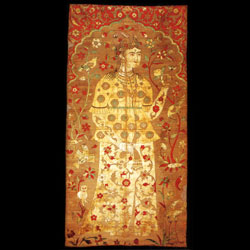
Many people think that Islam prohibits figural representation, but this is not true. The Koran, the Muslim scripture, bans idolatry, or the worship of images, so images are not found in mosques and other religious settings. But many Muslims—like people everywhere—enjoyed pictures of people and animals in their everyday lives. Sometimes figures are shown realistically, as in this beautiful velvet from seventeenth-century Iran or India, inwhich an elegant lady sniffs a flower in a garden surrounded by birds and animals. in other cases, the figures are more abstract, making it possible to interpret the representation in several different ways.

Picture's Caption: Velvet with lady in a niche, 17th century, India or Iran. Silk and metal lamella spun around silk, 143 x 69 cm. 37/1995

Writing
The central miracle in Islam is the Koran, which Muslims believe was revealed in Arabic to the Prophet Muhammad in early seventh-century Arabia. Reverence for the word therefore became a primary theme of religious art, as artists endeavored to make the physical presentation of God's word as beautiful as its content. These two lines come from one of the largest manuscripts of the Koran ever made, a loose-leaf copy produced about 1400 for the congregational mosque built by the warlord Timur at Samarkand in Central Asia. Artists everywhere used verses from the Koran to decorate Islamic art and architecture, and the appreciation of beautiful writing led them to exploit the decorative potential of Arabic script by developing many styles to use in different media and contexts.

Picture's Caption: Leaf from a large Koran manuscript written in Muhaqqaq script, 1400-1405, Afghanistan. Ink and gold on paper, 45 x 98 cm. 20/1987

Geometry
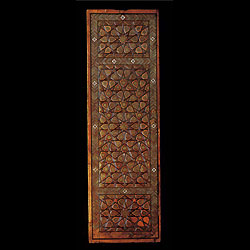
Artisans in the Islamic lands expanded the pre-Islamic repertory of geometric designs to create stunning compositions based on strapwork and tile patterns of triangles, squares, polygons, stars, and other regular forms. Many designs start from 45° or 60° grids that yield patterns of 8-pointed stars and hexagons, while others, such as this panel from a pair of seventeenth-century Iranian doors, are based on an extremely complex arrangement of pentagons and ten-pointed stars. Each individual element is made up of hundreds of minute rods of wood, bone, and metal that were glued together in other geometric patterns and then sliced to form tiles. Mathematicians in the Islamic lands were extremely sophisticated (algebra and algorithms, for example, were brought to the West by Muslim scientists), but artisans seem to have worked out most of these designs—even the most complex examples like this one—using traditional "tricks of the trade" without recourse to higher mathematics.

Picture's Caption: One side of a double door, 17th century, Iran. Several types of wood; patterns inlaid with brass, ivory, and wood, 242.5 x 74 x 8.7 cm. 35/2000

Vegetation
Artisans in the Islamic lands also inherited a rich tradition of decoration with vines, stems, leaves, and flowers. Vegetal ornament was used regularly and consistently in all the arts throughout the region. The depiction of lush vegetation and verdant gardens was undoubtedly attractive to the inhabitants of this dry and often dusty part of the world, and these designs may also have recalled the Garden of Paradise promised to Muslims in the Koran. Sometimes artists depicted gardens realistically, but their most distinctive achievement was the transformation of naturalistic vegetal ornament into the arabesque, an abstracted form in which plants and leaves grow according to the laws of geometry rather than nature. In these large tiles from the hood of a fourteenth-century Persian mihrab (the niche in the Mecca-facing wall of a mosque), for example, the vines and leaves grow in choreographed symmetry from a central source.

Picture's Caption: Mihrab tile, late 13th century, Kashan, Iran. Fritware, cast in two parts and painted in blue and turquoise in, and in luster over, an opaque white glaze, 76 x 74 cm. 1/1968

Hybrids
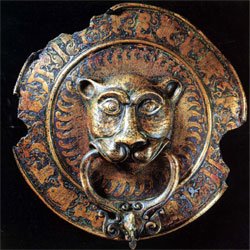
Artisans often combined these four themes within single works of art. This stunning doorknocker, probably made in southern Italy around the year 1100, for example, takes the shape of a lion's head which grasps a cock-headed ring in its maw. His mane is geometricized into a flame-like halo, and the whole composition is surrounded by an Arabic inscription set on a vegetal ground. The inscription, written as if the lion itself were speaking, states "I attest that there is no god but God and that Muhammad is His prophet." The inscription is thus a visual pun, written so that when the cock's head strikes the plate, it is as if the lion were roaring forth, attesting to his faith in Islam.

Picture's Caption: Lion-headed doorknocker, 11th century, Southern Italy. Cast and engraved bronze, partly inlaid with niello, 44.3 cm. 50/2000

Curated by Sheila S. Blair and Jonathan M. Bloom, Cosmophilia was organized by the McMullen Museum of Art, Boston College in collaboration with the David Collection, Copenhagen. Major support has been provided by the Calderwood Charitable Foundation, the National Endowment for the Arts, and the Patrons of the McMullen Museum. The exhibition is dedicated to Norma Jean and the late Stanford Calderwood, who did so much to foster the study of Islamic art at Boston College. This exhibition is supported by an indemnity from the Federal Council on the Arts and the Humanities.

August 25, 2006

"The Whole of It is from Our Lord"

The following question was asked about how much one could believe that the Qur'an was not written by Allah (swt) and still remain a Muslim:

And if some of it [the Qur'an] was "written by man," or a person believes that some of it was "written by man," how much of it must fall in that category before that person is, in your view "not a Muslim."


My answer:

The answer is quite simple: belief that any part of the Qur'an was "written by man" will cause one to fall out of Islam (i.e., become "not a Muslim").

"And those who are firmly grounded in knowledge say: 'We believe in the Book; the whole of it is from our Lord:' and none will grasp the Message except men of understanding.'" (3:7)

Islam is not a "cafeteria religion" where one can pick and choose which parts to believe in.

August 10, 2006

On Da'wah in the West

The following is a comment I wrote to Emmanuel, a Catholic Malaysian blogger, who was responding to a post written by MENJ regarding South Korean missionaries who are being expelled from Afghanistan. After posting this comment, I thought I would cross-post it onto this blog and some others.

Emmanuel: Da’wah, as practiced by Muslims in the West, is almost invisible. I do not say this negatively, merely as a statement of fact. In the US (at least), da’wah to non-Muslims is rarely done face-to-face, unlike, say, the Mormons or JWs. We don’t ride around the neighborhood on bicycles in white shirts and dark ties, asking people to convert. We also don’t pass out cartoon tracts like Jack Chick’s or booklets like the JW’s, leaving them lying around for people to read (although I will say I don’t think badly of the JW booklets). In fact, the only Muslim da’wah group I’ve ever met members of face-to-face were only interested in meeting other Muslims, trying to get lax brothers and sisters to become more devout. Certainly no one ever came up to me and asked me to become Muslim, which is more than the Christians (including some members of my family) can say.

I see by your blog that you’re Catholic (as I was, once, long ago). Muslims are like Catholics in that neither group really needs to do da’wah. If someone is interested in Catholicism, you try to answer their questions and perhaps provide a Bible to help them understand the religion or direct them to other people who are more knowledgeable. That’s how it is in Islam. For many Muslims in the West, the greatest source of Da’wah is the Qur’an itself. It was my study of the Qur’an over a period of four years that ultimately led to my becoming a Muslim. A lot of questions were answered for me by people on the internet, whether in the form of reading articles or by sending e-mails to ask peoplle questions, but in all cases it was I who made the initial contact.

But far too many Christian missionaries use underhanded tactics in trying to convert people. Unlike MENJ, I do think it is constructive, both in the long- and short-term, to ban missionaries. Read the famous article, The Stealth Crusade, published in Mother Jones magazine four years ago, and you’ll begin to understand some of our concerns.

April 18, 2006

firaushah.com - the blog

This post is to let my readers know that I'm going to semi-discontinue this blog, Dunner's Learn About Islam. All of these posts (and their respective comments) have been imported into my new blog, firaushah.com - the blog, which is associated with the new Islamic online store Milady and I have been creating, firaushah.com. That blog will continue with the DLAI tradition of answering questions about Islam and trying to correct the many misconceptions people have about Islam and Muslims; however, I will also use that blog to let my customers know about new products that firaushah.com will be selling. The purpose of firaushah.com is to beautify Muslims, both internally and externally, insha'allah, and I think these two sides coming together will both fulfill firaushah.com's mission and benefit you, my readers.

In the meantime, I'm leaving this blog up as it still gets a fair number of hits from people looking for information about Islam. However, firaushah.com - the blog will be getting all the new material, insha'allah. For those of you who have linked to this page (or would like to link to the new blog), the new URL is http://firaushah.com/blog/ .

April 06, 2006

Peace and Love in the Qur'an

Dr. Juan Cole, over at Informed Comment, normally blogs about modern Middle Eastern politics and current events. However, he's recently written up some very good explanations (tafsir) regarding five (so far) Qur'anic ayat, under the general heading, Peace and Love in the Qur'an. The five ayat are:

4:90

4:94

5:82

25:63

28:55

Check it out.

April 01, 2006

Prevention Is Better Than Cure

Khutbah from the Islamic Religious Council of Singapore (MUIS)
31 March 2006 / 1 Rabiulawal 1427


Blessed Friday congregation,

Come; let us be better human beings in this world. Make this day better than yesterday and prepare for tomorrow so that it will be better than today. We do not know when Allah (swt) will call us to return to him. Hence, remain conscious of Allah (swt) till the end of our lives.

Nowadays we often hear about the outbreak of a very dangerous disease. This virus has spread widely to a number of countries. This virus continues to spread and can cause death if it is not treated. This virus is known as Avian Flu or Bird Flu.

As Muslims, we perceive this virus as a test from Allah (swt) on our faith and patience. Allah (swt) says in the holy book, Al-Qur'an,

“And certainly, We shall test you with something of fear, hunger, loss of wealth, lives and foods, but give glad tidings to As-Sabirun (the patient ones). Who, when afflicted with calamity, say: 'Truly! To Allah (swt) we belong and truly, to him we shall return.'”
(Surah Al-Baqarah, 2:155-6)

In facing this test, it does not mean that we leave everything to Allah (swt) or fate. According to the teachings of our Prophet Muhammad (saw), first we have to make an effort and then leave the outcome to Allah (swt) (tawakkal).

This concept was taught by our Prophet, when a man asked him whether to tie his camel to a pole or just to leave the camel and hope it wouldn’t stray away. The Prophet (saw) replied briefly:

“Tie it first, then leave it to Allah (swt) to take care of it (tawakkal).”
(Narrated by Imam Tarmizi.)


Blessed Friday congregation,

Have you ever heard a saying that there’s a medicine/cure for all diseases? Yes, the Prophet (saw) actually once said:

“Allah (swt) never sends down a disease to mankind without sending down a cure for it."
(Narrated by Imam Bukhari.)

From this hadith, we can understand that for every sickness there is a cure for it. We should believe in this, but in actual fact that there are still some diseases with no cure. Does this fact have any contradiction with the hadith?

What we can understand from this hadith is that it is possible the cure has not been found yet. We can also understand that this hadith encourages mankind to take prevention from diseases, meaning that prevention is a type of cure.

Hence, prevention is better than cure. Prevention is the form of effective antidote for several diseases. An example is that by taking care of our eating habits (diet), reducing the sugar and salt intakes, one can be protected against high blood pressure, diabetes and other diseases.

One who does not take the necessary steps of prevention, he or she is exposing himself or herself to danger and the destructive curse. As the Prophet (saw) had explained:

“A believer should not humiliate himself. A companion asked, 'How can one humiliate himself?' The Prophet (saw) replied, 'By exposing oneself to the curse that is beyond one’s capacity to cope with.'"

Therefore, before the danger comes to us, we must take precautions to safeguard the public and ourselves.

What are the necessary precautions that one can take to guard against the outbreak of Bird/Avian Flu?

The first step is cleanliness. Cleanliness is part of our Iman.

Because of this, a Muslim does not only clean the soul but also the physical self. This is shown in our daily prayers, we are asked to take ablution 5 times a day. It is also sunnah to wash the hands up to the wrist whenever ablution is taken. We are also encouraged in taking care of our cleanliness by being careful about what we eat. We should eat food that is halal and tayyib (nutritious). We are also encouraged to take care of our environment.

Therefore, taking care of our hygiene is the first important step to protect oneself from the Avian/Bird Flu.

The second step is to protect our health. It is our duty to take good care of our body. As the Prophet Muhammad (saw) had explained,

“Definitely your body have the rights over you.”
(Narrated by Imam Tarmizi.)

To take care of our body, we have to do good things that will ensure good health. An example is to exercise at least 3 times a week. We ought to have a balanced diet. We should not destroy our health by smoking or consuming things that are haraam, such as drugs or alcohol.

The last step, which is very important, is by strengthening our faith and our iman.

As Muslims, having faith in Allah (swt), we believe that all that is good and bad comes from Allah (swt), and that it is we who have to ask Allah (swt) to protect us, our family and the public from the outbreak of Avian/Bird Flu. We should seek help from Allah (swt) that this outbreak of disease should go away from us.

Dua is a weapon for a believer. Have faith in our dua, and seek help from Allah (swt). Remember, the Prophet (saw) once said:

Dua can protect against the test that had been sent down and also those which have not been sent down. When the test was being sent down, the test and dua will clash against each other until the Day of Judgement.”
(Narrated by Hakim.)


My beloved brothers,

Muslims are the ones who are always aware of what happens around them. With the attribute of the blessing and showering of love to each and every creation of Allah (swt), we can play a role in preventing this outbreak.

We as Muslims should play a major role in preventing this outbreak.

All good things should begin from us Muslims by holding strongly to the religion of Allah (swt) – Islam. With the help of Allah (swt), we will be able to be the role model and bring blessings to mankind.


Glossary:
As-Sabirun: The patient ones, those who are patient.
Dua: Personal prayer, supplication.
Halal: Lawful, permitted. For more information, see Wiki: Halal - Dietary Usage and Wiki: Islamic Dietary Laws for more information.
Haraam: Forbidden; the antonym or opposite of Halal.
Iman: Faith in Allah (swt).
Rasulullah: The Prophet of God; i.e., Muhammad (saw).
(saw): These letters are abbreviations for the words "Salla Allahu 'Alaihi Wa Sallam," which means, "may the blessing and the peace of Allah be upon him." When the name of Prophet Muhammad is mentioned, a Muslim is to respect him and invoke this statement of peace upon him.
Sunnah: In this context, sunnah means a recommended practice, something that should be done but is not obligatory.
(swt): These letters are abbreviations for the words of "Subhanahu Wa Ta'ala." When the name of Almighty Allah is pronounced, a Muslim is to show his respect to Him by reciting this. The meaning of this statement is that Allah is purified of having partners or a son.
Tawakkal: "To leave everything up to." For example, "tawakkal alallah," which means to leave everything up to Allah (swt).
Tayyab: Nutritious.

March 25, 2006

Upholding Islamic Principles at All Times

Khutbah from the Islamic Religious Council of Singapore (MUIS)
24 March 2006 / 24 Safar 1427


Blessed Friday congregation,

Fear Allah truly and safeguard your akhlaq and your faith, for these are the principles in a believer’s life.

Rasulullah (saw) once said in a hadith:

There will come a time when those who are patient in their religion, will be like the ones who have burning coal in their hands.
(Narrated by Imam Tarmizi.)

The world today is developing rapidly. Mankind has achieved much advancement and developments. Scientific and technological developments have helped man lead a much better life. However, we cannot deny that living in a modern world has tremendous challenges too. We can now see the many kinds of cultures and ways of living that have resulted from this modernization.

Because of this, Rasulullah (saw) said that there will come an age when those who are patient with their religion will be like the ones who hold burning coal in their hands. Is this the time? Let us think about it.


My beloved brothers,

Life at this age has much exposure. There are many things that can lead a Muslim away from his Islamic principles. A Muslim can choose whichever path he wants. But what are the things that can help a Muslim be steadfast in his religion at this age and at the same time able to adapt to modernization?

Listen to what our prophet Muhammad (saw) said:

Let not any of you be a follower by saying: (My principle or character) depends on the majority. If the majority is good, I will be good and if the majority is bad, I will be bad. But you must strengthen your principles. If the majority is good, you will be good. If the majority is bad, you will correct them.
(Narrated by Imam Tarmizi.)

We as Muslims are obligated to remain steadfast in our religion, especially in faith and good character. We must know where are the limits and boundaries.

In practicing religion in today’s context and living in a multi-racial society, we must be wise in adapting ourselves, and not sacrificing our Islamic principles at the same time, especially in issues of faith and good character.

For instance, Islam has been tainted with many negative impressions. However, it is not only the ignorant who are ruining the image of Islam with lies and insults, but we Muslims ourselves are blemishing Islam. Just look at the many riots and violent outbursts done in the name of Islam. Do we not ask, where is our akhlaq? Did Rasulullah ever teach us to damage the property of others to uphold Islam? Is this the true Islam?

Another example is through the internet. As Muslims, we must be wise in using it. With a strong faith, we will be God-conscious wherever we are. We will not visit websites which are unbeneficial, such as porn sites and others. Instead we should use the Internet to spread the message about our religion, Islam.

Another characteristic, which is rampant these days and is often linked to modernization, is unhealthy mixing of the genders. A lot of them can be seen holding hands in public. Not only that, some even go to the extent of hugging. There are also those who dare to kiss, without feeling ashamed. What should the limits be? According to the mind, you can socialize without limits as long as there is no sexual intercourse. According to lust you can have sex, as long as one is not pregnant. According to Allah’s laws, all doors which lead to illegal sexual intercourse should be avoided. Not only holding hands, even touching is not allowed.


Blessed Friday congregation,

In trying to adapt, we must remember the limits placed by our religion. Everything is clear. We must ensure that our Islamic principles are not compromised. We should explain to the society our limits and boundaries. We must be wise in explaining all the wrong misconceptions about our religion.

In adapting, we must ensure that it is according to our religious principles. For instance, although we are living in a non-Islamic country, we must open our eyes to understand that the state’s laws must be obeyed because they are based on justice among mankind. And this is also a principle in Islam.

We must live the true spirit of Islam. By seeking knowledge and understanding that everything we do because of Allah is an ibadah and we will be rewarded accordingly. With this spirit, we will be able to develop ourselves and at the same time, bring ourselves closer to Allah.

We also need to show good character wherever we are, because that is the true personality of a Mukmin. By doing this, we will be able to adapt without compromising our faith or good character.


My beloved brothers in Islam,

The splendid strength of faith and character was shown by a Follower’s Follower named Rabi’ bin Khuthaim. Because of his faith, there was jealousy among the Fasiq, until there was a reward of 1000 dirham to a beautiful woman who could seduce Rabi’ bin Khuthaim.

So the woman dressed up prettily and put on perfume. Then the woman went to meet Rabi’ while he was leaving the mosque. Rabi’ bin Khuthaim was surprised with the state of the woman.

Rabi’ said to the woman: "How would your condition be when you are inflicted with a disease, when your skin color and your beauty are affected? How would your condition be when the Angel of Death comes and takes away your soul? Or when the angels Munkar and Nakir come to torture you?”

Upon listening to the words of Rabi’, the woman cried and cried regretting her actions, and then she went back home and repented.

Let us learn from this story. May Allah help us in living the religion. The Muslim society which has high moral values and spirituality is actually a strong tree as depicted by Allah (swt) in the Al-Quran:

"See you not how Allah sets forth a parable? A goodly word as a goodly tree, whose root is firmly fixed, and its branches (reach) to the sky. Giving its fruit at all times, by the Leave of its Lord, and Allah sets forth parables for mankind in order that they may remember."
(Surah Ibrahim, 14: 24-25)


Glossary:
Akhlaq: Literally, "disposition." The practice of virtue, morality and manners.
Dirham: A unit of currency.
Fasiq: One of corrupt moral character who engages in various sins.
Ibadah: Literally, "worship." This term refers to any and all acts that demonstrate obedience and commitment to God. Thus, in Islam, visiting the sick, giving charity, hugging one's spouse, or any other good act is considered an act of ibadah.
Munkar and Nakir: Two black, blue-eyed malaikah (angels) who test the faith of the dead in their graves. For more information, see the Wikipedia article: Nakir and Munkar.
Rasulullah: The Prophet of God; i.e., Muhammad (saw).
(saw): These letters are abbreviations for the words "Salla Allahu 'Alaihi Wa Sallam," which means, "may the blessing and the peace of Allah be upon him." When the name of Prophet Muhammad is mentioned, a Muslim is to respect him and invoke this statement of peace upon him.
(swt): These letters are abbreviations for the words of "Subhanahu Wa Ta'ala." When the name of Almighty Allah is pronounced, a Muslim is to show his respect to Him by reciting this. The meaning of this statement is that Allah is purified of having partners or a son.

March 22, 2006

Meditation of the Prophet (pbuh)

Masjid al Nabawi, by Google EarthWhen becoming humiliated, remember the Prophet in Ta’if.

When being starved, remember the Prophet tying two stones to his stomach in the battle of Khandaq.

When becoming angry, remember the Prophet’s control of anger on the martyrdom of his beloved Uncle Hamza.

When losing a tooth, remember the Prophet’s tooth in the battle of Uhud.

When bleeding from any part of the body, remember the Prophet’s body covered in blood on his return from Ta’if.

When feeling lonely, remember the Prophet’s seclusion in Mount Hira .

When feeling tired in Salaat, remember the Prophet’s blessed feet in Tahajjud.

When being prickled with thorns, remember the Prophet’s pain from Abu Lahab’s wife.

When being troubled by neighbours, remember the old woman who would empty rubbish on the Prophet.

When losing a child, remember the Prophet’s son, Ibrahim.

When beginning a long journey, remember the Prophet’s long journey to Madinah.

When going against a Sunnah, remember the Prophet’s intercession, (Ummati, Ummati, Ummati) (My Ummah).

When sacrificing an animal, remember the Prophet’s sacrifice of 63 animals for his Ummah.

Before shaving your beard, remember the Prophet’s face rejecting the two beardless Iranians.

When falling into an argument with your wife, remember the Prophet’s encounter with Aisha and Hafsa.

When experiencing less food in the house, remember the Prophet’s days of poverty.

When experiencing poverty, remember the Prophet’s advice to Ashaab-e-Suffa (People of Suffa).

When losing a family member, remember the Prophet’s departure from this world.

When becoming an orphan, remember the Prophet’s age at six.

When sponsoring an orphan, remember the Prophet’s sponsor for Zaid ibn Haritha.

When fearing an enemy, remember the Prophet’s saying to Abu Bakr in Mount Thour .

Whatever situation you may find yourself in, remember your role model, the best of creation: Prophet Muhammad.

Whatever you may do, remember that your deeds are presented before our Prophet. Are we pleasing him or displeasing him?

March 05, 2006

The Importance of Faith

Khutbah from the Islamic Religious Council of Singapore (MUIS)
3 March 2006 / 3 Safar 1427


Masyiral Muslimin wa zumratal Mukminin Rahimakumullah,

I call upon myself and my brothers here to fear Allah s.w.t. truly, by doing all that He commands, and leaving all that He forbids.

For us to reach the level of taqwa, which is demanded, we must strengthen our faith in Allah s.w.t. Because taqwa is the reflection of faith in the heart, faith can rise and fall, increase and decrease.

A person’s faith decreases when he commits a sin. And it is because, when he commits the sin, he is not aware or forgets his faith, the sacred faith in the oneness of Allah. Whereas his faith grows when he strengthens his belief in the oneness of Allah s.w.t.

Therefore, faith is something which is of the utmost importance for Muslims. Its importance exceeds all the other aspects of religious obligations. There is no point if a Muslim prays and does ibadah day and night, if his faith is flawed. Allah s.w.t says in Surah Az-Zumar, verse 65:

"And indeed it has been revealed to you (O Muhammad), as it was to those (Allah’s Messengers) before you: 'If you join others in worship with Allah, (then) surely (all) your deeds will be in vain, and you will certainly be among the losers.'"


My brothers in Islam,

The religious scholars of the past had placed a very clear principle for us. The principle is:

"The first thing in learning Islam is by learning about Allah first."

We must know Allah, our God. This is the condition to be known as Muslims. We need to know, what are our principles? What is our faith? When a person does not know Allah, there will be many deviations in beliefs and teachings which may involve performing ibadah like a Muslim but is not.

How do we know Allah?

We are not like believers of other religions who can depict their gods. We cannot depict Allah, because our minds will never be able to comprehend that. So the way to know Allah is through His Attributes, and the meanings of His Glorious Names. Not from His Essence.

Our religious scholars have taught us an easy way to know the Attributes of Allah. Just by learning and understanding the obligatory 20 attributes. These attributes are based on Al-Quran and Hadith. Attributes such as Wujud, Qidam, Baqa’, Mukhalafatuhu lil hawadith, and others.

All these are part of the legacy of our religious knowledge. It is very important to be learnt and taught to the Muslim community at this age, especially to our new generation. Because being ignorant of these obligatory Attributes of Allah will expose one to the dangers of associating partners to Allah s.w.t., which will finally nullify his faith.

Whereas the 99 names of Allah have been stated by Rasulullah s.a.w. in his hadith. We are required not only to memorize them, but to learn and understand them.


Maasyiral Muslimin rahimakumullah,

Observing all His creations around us can further strengthen the faith, which is embedded in our hearts through our understanding of the attributes, and His Glorious Names. All that we can see are evidence for the existence of Allah, and His Glory. Allah s.w.t. says in Surah As-Fussilat, verse 53:

"We will show them Our Signs in the universe, and in their own selves, until it becomes manifest to them that this (the Qur'an) is the truth. Is it not sufficient in regard to your Lord that He is a Witness over all things?"

In the Al-Qur'an itself, there are so many verses urging us to observe the creations of Allah s.w.t., so we may understand the Greatness and Glory of Allah s.w.t. Just look at the familiar verses recited in the Friday prayer, in Surah Al-Ghaasyiyah, verse 17-20:

"Do they not look at the camels, how they are created? And at the heaven, how it is raised? And at the mountains how they are rooted? And at the earth how it is outspread?"

In these verses, Allah s.w.t. brings forth an example of an animal with such miraculous creation, the camel; the only large mammal which can live for a long time at a very dry place without food or water. This is where there is evidence pointing towards Allah’s All-Encompassing Knowledge, Who designs each creation in accordance with its living habitat. A principle which scientists call ‘Adaptation.’

And then Allah s.w.t. brings our attention to an object larger than the camel. Which is the sky above us. So wide the sky is, it contains thousands of millions of stars and galaxies.

When a person is able to understand the vastness of this universe, he will see how insignificant and unimportant the earth is, it is like a speck of dust in the middle of a vast desert of no value at all. But, the wealth and richness of the earth is what makes man fight and compete, until he forgets that Allah is always watching him, and that what he gets will fade away when he dies.

Do realize this, my brothers. Seek wealth. Work for wealth. But let it be according to the laws laid by Allah s.w.t. And do not ever let this world stay in our hearts, until we forget our real purpose living in this world.


Blessed Friday congregation,

We want to be an excellent ummah. Well-respected. Khaira Ummah, the best ummah. But, we will never achieve all this without strengthening our faith and our children’s faith. Faith is the pulse of life in Muslims. There is no compromise in faith.

So, let us step up our faith and our children’s faith. Learn to know Allah through His attributes, His Names. Increase our iman by continuing our pursuits in learning, studying and observing the creations of Allah. It is only with a strong unshakable faith that we can be successful Muslims in this world and the hereafter.

February 26, 2006

Itqan in the Practice of Helping Others

Khutbah from the Islamic Religious Council of Singapore (MUIS)
24 February 2006 / 25 Muharram 1427


O mankind, do not waste even a second of your time. Allah witnesses your every act, and every deed will be accounted for in judgment day. Allah the Most Powerful is Most Able to cause death upon us anytime. So are we ready? How do we get ready?


In the past week's sermon, we have listened and understood that Islam is the religion which encourages its believers to help each other in goodness and how Muslims are given the responsibility to bring benefits to all.

When Allah (swt) says that Muslims are the best of mankind, this verse mentions that we will reach that level of excellence by doing good and forbidding evil with a sincere faith in Allah.

In doing something, we must make sure that it is an act of ma’aruf (goodness), be it in work, studies, sports or ibadah.

In doing an act of ma’aruf (goodness), it must be done with sincere intentions. Not only that, we must make sure that the act will result in an impactful contribution to society; a contribution which is our responsibility as a believer.

Remember what Rasulullah once said in a hadith narrated by Imam Tabrani:

“Indeed Allah loves one who does work, he does it with itqan.”

Itqan here means the attitude of being careful, meticulous, hardworking and excellent in carrying out responsibilities and tasks. Our responsibilities are not towards Allah only, but towards our employers, teachers, students, and all.

In fact, itqan should be implanted in the heart of a believer in Allah (swt) and the Day of Judgment, for it shall be the day when every deed that we have done will be shown to all, in accordance with Allah’s promise, Surah At-Taubah, verse 105:

“Do deeds! Allah will see your deeds, and (so will) His Messenger and the believers. And you will be brought back to the All-Knower of the unseen and the seen. Then He will inform you of what you used to do.”


My beloved brothers in Islam,

Those who strive hard and work hard will get what they are working for. Those who do not give up are those who have itqan in them. Itqan is a reason for achievement and excellence.

Indeed this is what has been shown by Rasulullah (saw). He did not give up in spreading the message to his people. Rasulullah (saw) was ridiculed, insulted, to the point where pebbles were thrown at him, but Rasulullah (saw) still continued with his dakwah.

The fruits of his endless dakwah prove the itqan and strivings in his acts. From just one person, he succeeded in islamicizing the city of Madinah. After that, he managed to gain back Makkah. Until after only 23 years he spread the message, he was able to take control of a major part of the land of the Arabs.

His companions continued this dakwah effort with much strivings and itqan. In less than 100 years since Rasulullah introduced Islam, Islam had spread to Africa and Europe. And it continued to spread to China and India.

Alhamdulilllah, with such efforts, Islam finally spread to the Malay Archipelago, and now we are in this mosque, we are believers, because of the hard work and determination of those who do the work of dakwah without ever giving up.


My blessed brothers in Islam,

With this itqan virtue, we do not have to doubt the quality of the work we produce. We do not have to worry about complacency and selfishness. A society with itqan will be more proactive and responsible. A society with itqan will be more sensitive of their own conditions, and there will be awareness and consensus among all parties.

Let us not be among those who tarnish the good image of Islam. We are all responsible of keeping up the positive image of Islam to others, and this can be done by showing itqan in all that we do. This will not only remove all wrong misconceptions about our religion, it will also increase our standing in society, where the standing can be seen as ties in strengthening the harmonious relationship between race and religion.

Do not take these ties lightly. We should work hard in improving these ties of understanding and compromise, because Allah (swt) may test the strength of these ties any time. Strengthen the ties among us with this virtue of itqan, by helping each other and being beneficial towards all. Hopefully these virtues make us a respected society, a community and an ummah, which will be the pride of our prophet, Muhammad (saw).

February 17, 2006

Helping Each Other in Goodness

Khutbah from the Islamic Religious Council of Singapore (MUIS)
17 February 2006 / 18 Muharram 1427


Maasyirah Muslimin Rahimakumullah,

I call upon myself and to my brothers here, to fear Allah s.w.t. as how He should be feared, to have taqwa in ourselves, taqwa which can instill in us the value of helping others; in matters of goodness and piety and in doing all that He commands and abstaining from all that He forbids.


Blessed Friday congregation,

As its name suggests, Islam is a religion of peace and harmony. And on this basis, Islam sets the nature of relationship between man, between race and nation, based on the concept of love for peace and harmony, not for enmity and hostility.

This can clearly be seen from Rasulullah s.a.w., who without doubt is a blessing to mankind, so that we may succeed in this world and in the hereafter, as stated in the Quran:

"And We have sent you (O Muhammad) not but as a mercy for the ‘Aamin (mankind, jinn and all that exists)." (Surah Al-Anbiya’ (21): 107)


My beloved brothers in Islam,

Among the many things that can contribute towards peace and harmony is the virtue of helping each other in matters of goodness and piety, which is much demanded in Islam, because it brings about respect, love and brotherhood, and with this, there will be peace and harmony in the ummah.

This is in line with Allah’s command in Surah Al-Ma'idah (5): 2:

"And help you one another in righteousness and piety. But do not help one another in sin and transgression."


Blessed Friday congregation,

Allah’s command to help each other in goodness is not only limited to us Muslims, but it covers the entire mankind in matters that bring virtue to us all, especially in multi-racial Singapore where we Muslims live side by side with various ethnic and religious groups.

This is because a Muslim who is strong in faith and taqwa is the one who has good relationships with others, even with non-Muslims.

At the same time, Islam encourages Muslims to avoid from instilling hostility and negative misunderstandings among man.

Allah s.w.t says in Surah Al-Anfaal (8): 25:

“And fear the fitnah (affliction and trial) which affects not in particular (only) those of you who do wrong (but it may afflict all the good and the bad people).”


Blessed Friday congregation,

Helping each other in beneficial matters among Muslims and non-Muslims is not something new in Islam. It has existed since Rasulullah’s time, even when the Muslims were in Madinah, they lived in a society made of various races and religions. And this included the Jewish community. In order to ensure religious and racial harmony, Rasulullah s.a.w., as the leader of the city, had introduced a treaty between the occupants of Madinah, including the non-Muslims, a treaty which is known as the Treaty of Madinah.

Among the terms stated in the treaty was that each Madinah citizen must maintain close cordial relationships among themselves, regardless of religion or heritage. They must advise each other in promoting goodness and forbidding evil.

This principle of helping each other towards goodness among mankind, including non-Muslims as stated in the treaty of Madinah is also in line with Allah’s Words in Surah Al-Mumtahanah (60): 8

"Allah does not forbid you to deal justly and kindly with those who fought not against you on account of religion nor drove you out of your homes. Verily, Allah loves those who deal with equity."

Now we know that Allah encourages us to help each other in beneficial matters, among Muslims and non-Muslims too, and the benefits and positive effects which can be gained from this good virtue.

So it is time for us to ask ourselves, to judge ourselves, is our virtue of helping others towards goodness limited only among the Muslim society? Have we ever thought of not helping someone who is in need if the person is a Non-Muslim Chinese or Indian? If the answer is Yes, then we need to change this wrong perspective and work towards widening the scope of helping others, including the non-Muslims.


Blessed Friday congregation,

Among the many examples of helping each other which can contribute towards mankind, passing over boundaries of religion, country or race, is by involving ourselves in humanistic efforts organised by associations such as Mercy Relief, Red Cross Society, and others. This can be done in any association as long as the activities do not go against the teachings in Islam.

This can be done by contributing donations or by participating directly in the humanistic missions such as volunteering and others.

The involvement of Muslims in such activities will portray Islam as a religion that places importance on harmony by encouraging the spirit of love for brotherhood and volunteering. This is because these associations are always involved in helping every time there is a calamity or tragedy, regardless of nation, religion or skin colour.

May our efforts in contributing and helping each other in goodness among mankind be blessed by Allah s.w.t. and may we be among those mentioned in a hadith:

"The best men are those who are most beneficial towards others." (Hadith narrated by Imam Baihaqi)

May our efforts in helping all levels of society towards goodness keep up the good reputation of Islam and the good name of our prophet Muhammad s.a.w.

February 03, 2006

Why Muslims Don't Pronounce "Takfir"

George Carty asked: "Would it not be a good idea to refer to extremist terrorists like al-Zarqawi and the GIA as 'takfiris'?"

Good question, George; however, the answer is no.

Both the Qur'an and the sahih ahadith collections are strong in their condemnations of this practice. We are not to judge who is a kafir unless there is extremely stringent evidence against them. Unfortunately, there are some groups, such as Takfir wal-Hijra and the GIA, who take a too-liberal approach toward pronouncing people as kafirs when perhaps they shouldn't be; however, these same groups may suffer for their pronunciations of takfir in the hereafter.

According to the Qur'an: "O ye who believe! When ye go abroad in the cause of Allah, investigate carefully, and say not to any one who offers you a salutation: "Thou art none of a believer!" Coveting the perishable goods of this life: with Allah are profits and spoils abundant. Even thus were ye yourselves before, till Allah conferred on you His favours: Therefore carefully investigate. For Allah is well aware of all that ye do." (4:94)

The punishment for those Muslims who kill other Muslims is severe: "If a man kills a believer intentionally, his recompense is Hell, to abide therein (For ever): And the wrath and the curse of Allah are upon him, and a dreadful penalty is prepared for him." (4:93)

In the sahih collections are the following ahadith:

“Whenever a man accuses another of being a kafir or wrong-doer, this accusation will rebound on him if the one accused is not in reality a kafir or wrong-doer.” (Bukhari)

“The man who calls another kafir or enemy of God, and the latter was not such, this charge will indeed turn back upon the accused.” (Muslim)

“He who curses a believer, it is as if he has killed him. And he who accuses a believer of kufr, it is as if he has killed him.” (Bukhari)

There is a belief in Islam that we humans are not really in a position to judge who is a Muslim and who isn't. One never knows who will be accepted into Jannah (heaven), even at the last moment:

"Abu Sa'id al-Khudri reported Allah's Messenger (may peace be upon him) as saying: There was a person before you who had killed ninety-nine persons and then made an inquiry about the learned persons of the world (who could show him the way to salvation). He was directed to a monk. He came to him and told him that he had killed ninety-nine persons and asked him whether there was any scope for his repentance to be accepted. He said: No. He killed him also and thus completed one hundred. He then asked about the learned persons of the earth and he was directed to a scholar, and he told him that he had killed one hundred persons and asked him whether there was any scope for his repentance to be accepted. He said: Yes; what stands between you and the repentance? You better go to such and such land; there are people devoted to prayer and worship and you also worship along with them and do not come to the land of yours since it was an evil land (for you). So he went away and he had hardly covered half the distance when death came to him and there was a dispute between the angels of mercy and the angels of punishment. The angels of mercy said: This man has come as a penitant and remorseful to Allah and the angels of punishment said: He has done no good at all. Then there came another angel in the form of a human being in order to decide between them. He said: You measure the land to which he has drawn near. They measured it and found him nearer to the land where he intended to go (the land of piety), and so the angels of mercy took possession of it. Qatada said that Hasan told him that it was said to them that as death approached him, he crawled upon his chest (and managed) to slip in the land of mercy.
Muslim, Book 037, Number 6662

(There are slight variations to the story in hadith numbers 6663 and 6664; however, the basic story remains the same.)

Also, from Maulana Maudoodi (May 1935):

It is in Hadith that once during a military expedition a man, when he saw the Muslims, said: “Assalamu Alaikum, there is no god but Allah, and Muhammad is the Messenger of Allah.” But a Muslim killed him, thinking that the man had proclaimed the Kalima just to save his own life. When the Holy Prophet heard of this, he was very angry, and he reprimanded that Muslim. But he replied:

“O Messenger of Allah, that man read the Kalima merely to protect himself from our sword.”

The Holy Prophet said:

“Did you open his heart and look inside it?”

A companion of the Holy Prophet asked:

“If a man (in battle) attacks me and cuts off my hand, but when I attack him he recites the Kalima, can I kill him in these circumstances?”

The Holy Prophet said: “No.” The companion said:

“O Messenger of Allah, he cut off my hand.”

The Holy Prophet said:

“Despite that, you cannot kill him. If you do kill him then he will have the rank which you had before you killed him, and you will have the rank which he had before he recited the Kalima.

In another hadith it says that the Holy Prophet said:

“If a man (in a battle) is attacking a kafir with a spear, and it has reached his throat, and at that moment he says ‘There is no god but Allah,’ the Muslim must immediately withdraw his spear.”

Another hadith records that

“to abuse a Muslim is an act of wrong-doing, and to fight a Muslim is an act of kufr.”

All these instructions were given because the strength and unity of the Muslims are based on the bond of faith and nothing else. If Muslims do not honour this bond, and they keep on cutting it on small things, the community will become disintegrated, and it will have no collective strength left to proclaim the word of God to the followers of falsehood and to invite them to good.


For more information about takfir, you might also look at:
Fitna-i Takfir (‘The mischief of calling Muslims as kafir’)
Wiki: Takfir